PLCs are widely used for valid reasons: they are dependable, familiar, and supported by well established engineering practices. However, many teams are discovering that PLC based systems can become increasingly difficult to justify as installations grow in size and complexity.
Cost is often the most immediate concern. PLC hardware can be expensive, and the overall investment increases further when proprietary modules, software licenses, and specialist engineering time are included. Even relatively minor modifications may require additional hardware, programming work, and on-site visits.
System complexity presents another significant difficulty. PLC installations frequently expand gradually over time, with new functions added as requirements change. As this happens, the control logic can become difficult to interpret, system documentation may no longer reflect the actual configuration, and troubleshooting can become heavily dependent on guesswork.
When a fault occurs, identifying its cause may take considerably longer than anticipated.
These challenges can ultimately contribute to downtime. Planned updates often require an outage, while unexpected faults may take an entire system offline. For processes that must operate continuously, such interruptions create substantial financial costs, as well as being highly inconvenient.
What Is Driving the Search for Alternatives to PLCs?
Many organizations are not specifically attempting to “remove PLCs.” Instead, they are responding to recurring operational difficulties associated with their existing systems.
Teams are seeking control solutions that are less expensive to install and simpler to maintain. They want to introduce changes without causing major interruptions, obtain a clearer understanding of system activity, and identify why particular actions are taking place.
Most importantly, they want control platforms that remain manageable throughout their service life rather than becoming progressively more difficult to operate.
For this reason, some organizations are considering alternatives to conventional PLC-based designs, especially in applications where flexibility and system availability are more important than following familiar approaches.
What Is the Alternative to a PLC?
Pi’s CRIUS®4.0 instrument controller was designed to address these specific challenges.
Instead of adding further layers to an already complicated PLC arrangement, the CRIUS®4.0 offers a more straightforward control platform that reduces dependence on costly proprietary PLC components. Systems developed and operated through the CRIUS®4.0 are easier to understand, simpler to modify, and less expensive to maintain over their operating lifetime.
The complete system is managed through a single unit with a clear, user-friendly interface. Where appropriate, site operators can make adjustments themselves, helping to reduce the cost and downtime associated with engineer callouts.
Alternatively, with customer permission, Pi’s engineers can access the CRIUS®4.0 remotely at the site and, depending on the nature of the problem, take the required action without traveling to the facility.
This approach reduces complexity and downtime while avoiding the introduction of unnecessary operational risk.
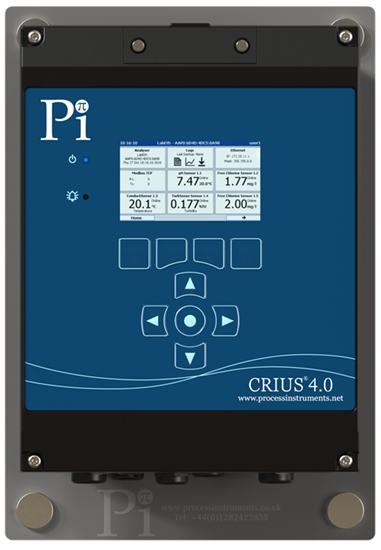
CRIUS®4.0 controller. Image Credit: Process Instruments (UK)
Has Replacing a PLC Actually Been Proven?
Yes. The CRIUS®4.0 is already operating as a PLC alternative in numerous systems around the world.
How the CRIUS®4.0 Replaced a PLC on a ClO2 Generation Site
At a ClO2 generation facility in Slovakia, the CRIUS®4.0 replaced the existing PLC by providing a different way to manage control complexity, rather than simply transferring the same logic to alternative hardware. The ClO2 generation process includes several stages, operating limits, and safety requirements that had previously been controlled through a progressively more complicated PLC program.
Over time, the original configuration became increasingly difficult to understand and modify, while fault recovery also took longer. By implementing the CRIUS®4.0 in place of the PLC, the control system was arranged in a clearer and more manageable structure. This made system behavior easier to interpret and allowed modifications to be introduced without adding further risk.
Operators obtained improved visibility of system activity, engineers spent less time deciphering control logic during fault investigations, and updates could be completed with less disruption to normal operation.
The outcome was a simpler and more resilient control system that satisfied the site’s operational and safety requirements while reducing downtime and the long-term support burden.
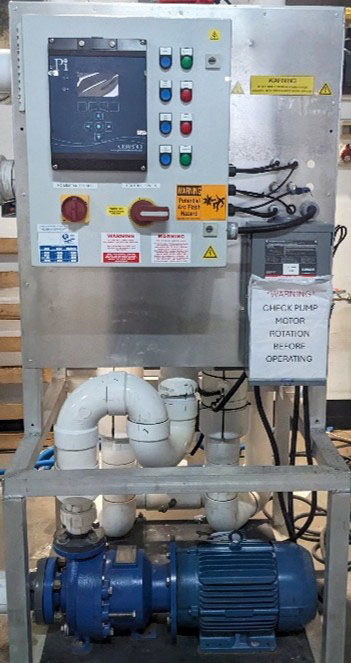
CRIUS®4.0 HypoSense monitoring and control system. Image Credit: Process Instruments (UK)
Can a CRIUS®4.0 Replace all PLC Systems?
No. The CRIUS®4.0 is a highly capable instrument controller that includes I/O, logic gates, ‘if and or’ functionality, data logging, remote access, PID control, and other features. Nevertheless, some PLC applications require greater hardware capacity or more extensive programmability than the CRIUS®4.0 can provide.
Where a control philosophy can be delivered using either a PLC or a CRIUS®4.0, however, the CRIUS®4.0 is often the simpler, more robust, and more resilient option.

This information has been sourced, reviewed, and adapted from materials provided by Process Instruments (UK).
For more information on this source, please visit Process Instruments (UK).